
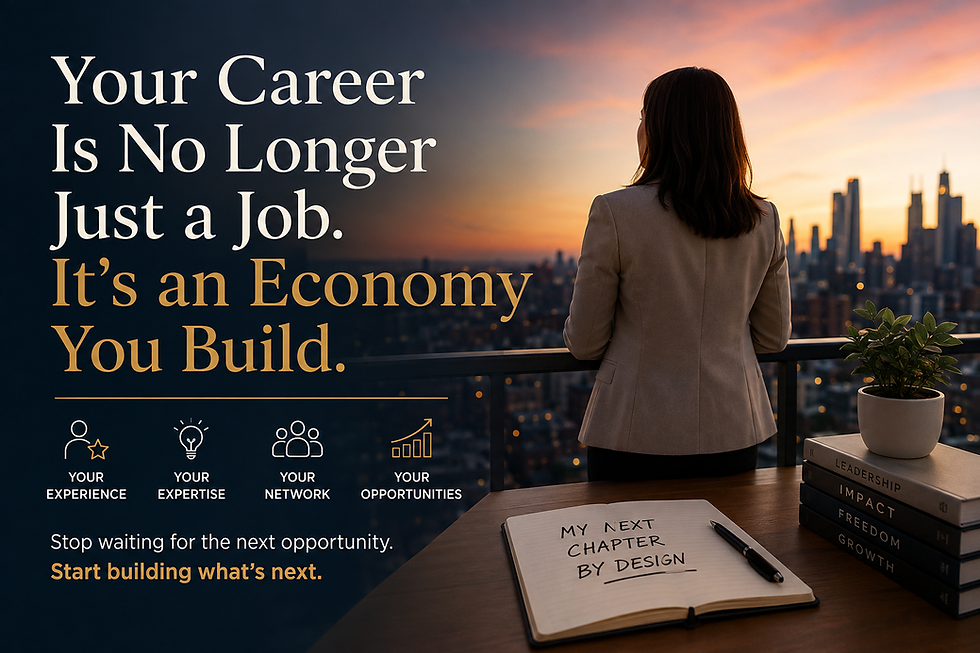
Your Career Is No Longer Just a Job. It's an Economy You Build.

We’ll Discover:
Do you feel that the traditional career model is the only way? Learn why that is not the case anymore.
Why and how does career reinvention happen as a slow process?
Why the experience you have built is your greatest asset.
What does it mean to build your own “career economy” and why that matters so greatly.
What happens when you stop thinking about your career as something an employer manages and start thinking about it as something you build?
When I started working with Scout Underwood, his perspective really stayed with me. He said something profound that is relevant to so many of us:
“The old paradigm doesn't work anymore. You've got to put yourself in a position where not only are you your own brand, but your own economy.”
That idea is worth sitting with.
Because the traditional career model was built around a fairly simple exchange: you joined a company, built your expertise, earned credibility, moved into larger roles, and expected that loyalty and performance would create some degree of security.
But the world of work has changed.
Companies get acquired. Leadership changes. Industries shift. Roles disappear. Technology changes the skills organizations need. Even successful careers can be disrupted by decisions that have nothing to do with your performance.
So what happens when you stop building your career around the assumption that one employer will always be there?
You start building something that belongs to you.
Your Career Has to Be Bigger Than Your Employer
Scout experienced that shift firsthand.
He joined Leap because he recognized that the traditional model wasn't enough anymore. He wanted to think differently about his career, his positioning, and what could come next.
And then he made his leap.
He moved into a CEO role at a new startup and stepped into a higher pay grade.
As he put it, that part “worked out swimmingly.”
But what I find even more interesting isn't just the outcome.
It's what happened next.
He came back to Leap.
Not because the first leap hadn't worked, but because his career had continued evolving and he wanted to invest in the next chapter with even more intention.
That second experience looked different.
He was more methodical. His network had grown. He had a larger body of work to draw from. And he had new tools available to him, particularly AI.
That is an important distinction.
Career reinvention isn't necessarily something you do once.
The skills you build, the relationships you develop, and the reputation you create can become the foundation for whatever comes next.
Your Body of Work Is an Asset
One of the most interesting things he shared was how he is using AI to build what he called a “digital doppelganger” of himself.
He has taken his body of work and is using it to help identify potential opportunities and matches with employers he has already targeted in a CRM.
That may sound like a technology story, but I think it is really a career strategy story.
You have spent years accumulating experience.
Projects. Results. Expertise. Relationships. Leadership lessons. Industry knowledge. Decisions you've made. Problems you've solved.
What happens when you stop treating those things as history and start treating them as assets?
That's where personal branding becomes much more than having a polished LinkedIn profile.
It's about understanding what you know, what you are known for, what problems you can solve, and where that combination could create value next.
AI can help you organize, connect, and activate that experience.
But the raw material still comes from you.
The Next Opportunity May Come From What You've Already Built
There was another part of his story that really stood out to me.
He said he didn't hesitate to write a book the second time around because “the material was there and the tools are there to stitch it together faster.”
Think about what that means.
The first version of his career gave him experiences.
Those experiences became knowledge. That knowledge became a body of work. And that body of work could then become a book, a new opportunity, a stronger network, a new leadership role, or something else entirely.
That's the power of thinking about your career as an ecosystem rather than a ladder.
You're not starting from zero every time you make a move.
You're building on what you've already created.
Your experience can become content. Your content can become visibility. Your visibility can create relationships.
Those relationships can create opportunities.
And those opportunities can lead somewhere you couldn't have predicted when you started.
That is a very different way of thinking about a career.
You Don't Need to Know Exactly What Will Work
Perhaps my favorite line from this conversation was actually the simplest:
“Even if just some of it works for you, it's a win.”
I love that because it takes some of the pressure out of career reinvention.
We often approach career change as though we have to make the perfect decision. Find the perfect role. Build the perfect brand. Choose the perfect next chapter.
But careers rarely work that way.
Sometimes you try something, and it opens a door. Sometimes it introduces you to someone. Sometimes it teaches you what you don't want. Sometimes it becomes something much bigger than you expected.
And sometimes only part of what you try works.
That's still progress.
The goal isn't to predict your entire future.
It's to build enough capability, visibility, relationships, and confidence that you have more choices when the future changes.
What Are You Building That Belongs to You?
This is the question I would encourage you to consider.
If your company disappeared tomorrow, what would still belong to you?
Your expertise? Your reputation? Your relationships? Your body of work? Your perspective? Your ability to solve problems? Your personal brand? Your network? Your knowledge?
Your ability to create something new?
Those are the assets that make a career more resilient.
And this is where I think the old career paradigm really is changing.
Your employer can be part of your career. It shouldn't have to be the entire foundation of it.
You don't have to leave your company tomorrow.
You don't have to become an entrepreneur.
You don't have to build a personal brand by posting every day.
But you can start building something that travels with you.
Because the future of your career may depend less on finding the one employer who can provide security and more on becoming the kind of professional who can continue creating value wherever the market takes you.
That's what it means to build your own economy.
And sometimes, the biggest leap isn't into a new job.
It's into a different way of thinking about your career.
Key Takeaways
The traditional career model is changing, making it increasingly important to build a career that is not entirely dependent on one employer.
Your personal brand, reputation, network, expertise, and body of work are career assets that travel with you.
Career reinvention doesn't necessarily happen once. Each experience can create new skills, relationships, opportunities, and possibilities for what comes next.
AI can help professionals organize and activate their experience, identify opportunities, and accelerate the creation of new career assets, but the value starts with the experience you've already built.
You don't have to know exactly what will work. Conversations, experiments, relationships, and new opportunities can create clarity as you move.
Building your own “career economy” doesn't mean becoming an entrepreneur. It means creating enough value, visibility, relationships, and options that your future isn't dependent on one path.
Frequently Asked Questions
What does it mean to build your own career economy?
Building your own career economy means developing professional assets that belong to you rather than relying entirely on one employer for your opportunities and security. Your expertise, reputation, relationships, personal brand, body of work, and ability to create value can all become part of that career economy.
How can I become less dependent on my employer without leaving my job?
You can begin by strengthening your professional network, developing your personal brand, documenting your accomplishments, expanding your expertise, creating a body of work, and exploring relationships and opportunities outside your current organization. Building career independence does not require an immediate career change.
Why is personal branding important for career security?
A strong personal brand helps people understand what you are known for, what problems you solve, and the value you can bring beyond your current title or employer. It can make your experience more transferable when you're pursuing a new role, industry, advisory opportunity, or entrepreneurial path.
How can AI help with career development and personal branding?
AI can help you organize your experience, identify patterns in your body of work, research opportunities, refine your positioning, create content, and identify potential connections between your expertise and opportunities in the market. The technology is most powerful when it is built around real experience and a clear understanding of what you want to accomplish.
Do I need to become an entrepreneur to build a career that belongs to me?
No. Building a career that belongs to you can mean developing expertise, relationships, visibility, advisory opportunities, speaking engagements, consulting work, board experience, or a strong professional reputation alongside your primary career. The goal is to create options and professional assets that aren't tied exclusively to one employer.


Comments