
David Rogier
The Corporate Ladder Is On Fire: How David Rogier Built MasterClass and What He’d Build Now
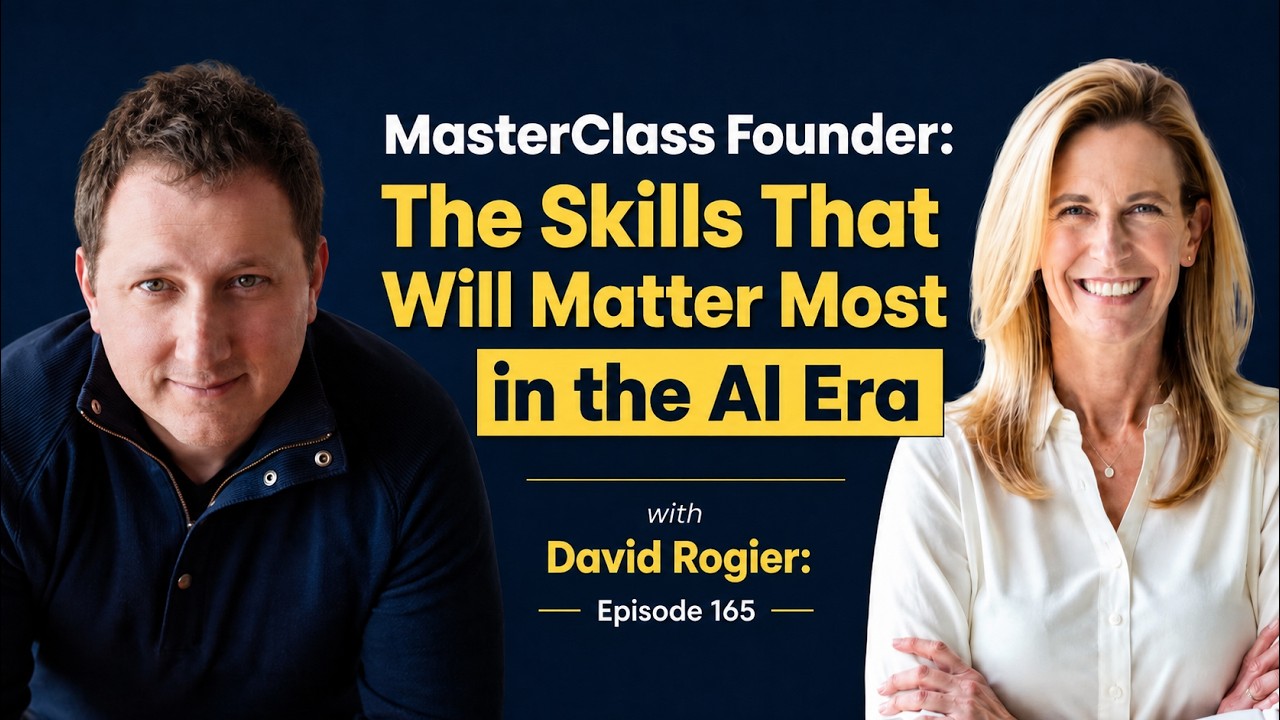
EPISODE #
165
In this episode...
At 16, his grandmother fled Kraków after the Nazis killed her father, worked a New York factory floor beside her mother, and applied to every medical school in the state three years running before one finally said yes — then told her second-grade grandson that education is the only thing nobody can ever take away from him.
Years later, David Rogier quit his venture capital job with no idea what he wanted to build, and his boss wrote him a check for $500,000 and told him to go think of something; the dark, formless year that followed became MasterClass, whose holding company still carries his grandmother's nickname. Launch day brought so few sales that he went home and cried, and by day four it was obvious he had a real business on his hands. In this conversation, David breaks down how he got Hollywood's biggest names to say yes, why he believes degrees and résumés are quickly becoming worthless, and the three kinds of jobs he thinks will actually survive AI.
David Rogier is the founder and CEO of MasterClass, the platform that put instruction from Martin Scorsese, Christina Aguilera, Steph Curry, and dozens of other world-class practitioners into the hands of millions of learners. He built it from a single $500,000 check and has since launched MasterClass Executive, an AI-native alternative to the traditional MBA created in collaboration with OpenAI and the University of Chicago Booth School of Business.
IN THIS EPISODE, ILANA AND DAVID WILL DISCUSS:
(00:00) Introduction
(01:34) The Grandmother Who Survived Kraków and Became a Doctor
(05:39) Stuttering, Teasing, and Parents Who Raised the Bar
(07:15) Quitting His Job and Getting Handed a $500,000 Check
(08:48) The Dark Year: What Happens When You Have No Constraints
(12:58) The Three Things That Had to Be True for MasterClass to Work
(14:33) The Lost Art of Opening Doors and Influencing People
(19:46) Launch Day: No Calls, Almost No Sales, and a Lot of Tears
(21:18) What Scorsese, Steph Curry, and Christina Aguilera Do Differently
(23:53) Why “Hire Great People and Get Out of Their Way” Is Terrible Advice
(27:28) The AI Study That Compressed 18 Months of School Into 18 Hours
(34:16) The Skills That Matter Now: Learning Velocity, Execution, People
(39:28) The Three Types of Jobs That Survive AI
(44:39) Burning the Corporate Ladder: Rebuilding the MBA for $2,500
(49:16) What He'd Tell His Younger Self
(51:52) Q&A: My Network Feels Crowded — How Do I Get Real Introductions?
We go through all of this in the full episode. Watch on YouTube or listen on Apple Podcasts or Spotify.


Full transcript (if you like reading instead of listening)
00:00
Here's what we were told. If you work hard, if you go to the right schools, if you get the right internships, you are going to climb, you're going to be safe forever, and you're going to earn enough to have a house to send your kids to go. It's not true. It's just not true.
00:13
Today's guest literally gave access to the world's greatest minds. David Rogier is the founder and CEO of MasterClass, and David turned a $500,000 bet from his former boss into a global phenomenon. It's a new world and the old ways of doing it are going away. So you got to find new ways to show that you have that skill set.
00:34
How do you see the skills forming?
00:37
I think the most important thing is
00:44
Hey, I have a favor to ask. I decided not to put any ads on the show because I don't want to vouch for things or products I don't really really believe in. But in order for us to continue to bring these amazing guests, all I'm asking is if that's okay, just click that like, subscribe, download button. Those mean to us more than you can think. So, is that a good deal? Let's dive in. Welcome. Welcome, David. This is going to be so fun.
01:13
I'm really excited to be here. It is an honor.
01:15
This is so so so cool. And just one more thing everybody you remember every week I do I do choose one question from our YouTube channel Leap Academy with Ilana Golan. And this week I saw a brilliant question from Punam who is asking about basically you know I'm reaching out to my network and I'm asking for introduction but it looks really crowded. What do I do? So we're going to answer this after this amazing conversation. David, your story is so so so inspiring. I gonna have to take you back in time a little bit. Can I take you back in time?
01:48
Of course.
01:49
This is going to be so fun. So, so tell me, so first of all, I was so touched the first time I heard about your story with your grandma. Share a little bit how did that like did you grow close? Like how did that inspire you? I I literally had tears in my eyes first time I heard this.
02:06
My grandma was my hero. She I'm just get a little emotional about it. She was everything to me and we you know I'd stayed with her after school almost every day. We would travel together once I got older. We would talk all the time and do do go out for lunch. I used to go with her to work and just work at her office with her, you know, at a fabric company. She was my hero.
02:39
She is my hero.
02:40
Yeah, she's my hero.
02:41
And she told you a lot about like what did she share? She she shares stories like how did you come into this realization that education is so important?
02:51
So I was in second grade. I still remember this. And I and I finished school that day and I came and I came I came to her house and my grandma always prepared for me a snack which now sounds
03:04
Like a ter a horrible snack, but I loved it as a kid. It was it was a bowl of apples and pickles. Sounds really gross now, but I don't know. I just apparently I really liked it. And I came home and I I came to her house and I was crying. I had a rough day in school and you know, I was in second grade, so like I, you know, it wasn't really that rough, but it seemed like rough.
03:29
It feels rough. Yeah.
03:30
Yeah. And my grandma told me that she has a story that she wants to tell me. And also in second grade, like that's the last thing that you really want to hear. So when my grandma was 16, she was she was living in Kraków, Poland, and she went on a family vacation with her mom. her dad decided to stay home a couple extra days to finish some work. While they're on vacation, the Nazis invaded. They killed her father and you know took everything. Her and her mom fled out of Europe to New York and they were able to get there and the only jobs that they were able to get were on a factory floor. So my grandma and her mom were working side by side. My grandma working in the factory decides that she wants to become a doctor. She applies by hand to every medical school in the state of New York and she gets a no from every single medical school in the state of New York. She keeps working the factory side by side with her mom and the next year decides I'm going to apply again.
04:32
I want to be a doctor. She again applies to every single medical school in the state of New York. Again gets a no from every single medical school in the state of New York. My grandma has some chutzpah and decides to call up the deans of admissions from every school and ask why am I not getting in. They all hang up on her except for one who says, "I'll be honest. You have three strikes against you. You are a woman, you're an immigrant, and you're Jewish." Hangs up with them. She keeps working the factory side by side with her mom. And next year decides to apply again to every medical school in New York.
05:02
She gets into one and becomes a doctor. And I'm staring at her because in second grade, this is intense stuff to be hearing from just having like been whining about math homework. And she turns to me and she goes, "Look, David, the point is is education is the only thing that someone can't take away from you."
05:21
And that put everything to perfection.
05:25
Yeah. Oh my god, that's so like if anybody's watching me on YouTube, I'm half crying here, but that that you know, I'll I'll tame myself. But this is such a beautiful story, David. And and speaking of like I assume that as a kid it it was not easy. You did have some stutter.
05:44
I still
05:45
And I I'm sure it was not easy as a kid. Like I'm sure you know kids know how to be pretty rough. Like what do you think it taught you?
05:54
Kids are rough. It was also hard with the adults because I clearly saw I wasn't being called upon because I stutter. And so not only you getting teased, but then you feel like you're not getting a fair shot to express yourself. And my mom and dad did something that was really interesting. They basically said whenever they had friends over for dinner, their expectation was that I would join them for dinner and I would converse with them.
06:19
Wow.
06:20
It was almost like we aren't going to let the fact that you stutter become an obstacle to you. In fact, we're going to hold you to a higher standard.
06:30
That was really I really appreciate that. in retrospect the negative side.
06:35
You probably hated it though. Like you probably hated it at the moment. Am I
06:39
Wrong?
06:39
Well, okay. So, I think I probably hate it at the moment, but then but then but then I came to like it because I'm now a chatterbox where it came to hurt me was back in school. I figured every teacher and adult wants to hear my point of view, which was not true and was isolated just to my parents. So, that got me into more trouble, but I think it was really good for my self-esteem.
07:02
[laughter]
07:03
I love that. And we're gonna have so much fun in this podcast then. So I love it. So take us like a little bit into the future. Because you've done a few things before MasterClass, but something like raised that idea of I actually want to start this thing. What was it? How did it even form?
07:23
So I was in grad school and I went and worked for after school at a venture capital firm. And I think a lot of things are going through my head that, you know, I have one chance and and I don't want to I have one life and I want to make it count. And what that meant for me is I don't want to be on my deathbed and hopefully a long time and not have at least tried to make the world a bit better. So, I went to my boss and I was like, "Hey, thanks so much, but I'm going to quit." And he asked me, "What am I going to do?" And I said, "I don't know yet, but I want to start something." He goes, "What?" I said, "I'm not sure." and he writes me a check for half a million and tells me to go think of an idea.
08:02
Wait, wait, wait. Take me, take me there for a second because like people don't just randomly write you.
08:08
It was incredibly generous. I think I mean nobody has ever done that for me obviously before. I mean part he's a venture capitalist, part I had worked for him and he was a professor of some classes so he knew me for a while. But I remember I mean if you can believe this long like I was like I need to think about it. That was my response. And I tried to act all cool and I walked outside and I called my mom and I told her and she's like what is there to think about you [laughter] know but it was like well yeah I you know like you know all this you know all this so I obviously said yes and then here's where like it was surprising response. The next year my life became very dark time in my life because for the first time in my life I didn't have any constraints. I felt such a moral pressure, if you will, to do something of impact. You also I can't complain about it to anybody cuz what what am I going to say?
09:09
I have half a million dollars. I can do anything I want. Oh, can I get a hug, please? I mean like
09:13
You lost the empathy. That's it.
09:15
I would have empathy for it. And
09:17
Somebody she gave me a great constraint. She said, "Choose something that even if it fails, you would be proud of it." That was a brilliant constraint to me. I think sometimes we need constraints to be create a to to spur our creativity and then I thought about my my grandmother and and you know the lessons I learned from her I just told you and so then you know I incorporated the company and our holding company is actually named after her. So, it's Yanka Industries, which was her nickname. And so, and I decided that I wanted to do something that it cannot be take. I can create something that other people can't take away from each other.
09:56
Oh, that's so powerful. Oh my god, that's amazing. So, so tell me, so and I want to go for a second into that dark place because in Leap Academy, we put a lot of focus on reinvention and because the people that we see usually have done a lot. They tick the, you know, some boxes of success and now they're like, "Who am I without my title? Who am I without my job? I want more for myself. I want to create a bigger life. I have no clue what it is." And that lack of clarity is really, really, really hard. So, how what, you know, take me to these baby steps for a second. I think it's debilitating in some ways because so much of our identity in the modern world is based on our profession and work. I'll even say more than that. I think so much of our we are incentivized and rewarded from a very early age to seek and gain the approval of others. And entrepreneurship is by nature a rejection of that.
11:02
So if you when you tell people about the idea I mean I told people about the ideas I had almost everybody says your idea sucks and that like really hits hard because at the time I mean you want good you want great grades you want your boss to give you promotion. You want your mom and dad to think you know that you whatever. Yeah.
11:23
Yeah. Exactly. And so and then you start realizing that in fact if nine out of people say your idea is good it's probably not a good idea because that means like it's a consensus idea. Entrepreneurship is usually about finding the thing the missed opportunity the opportunity other people do not see. So in fact now when nine out of 10 people say something's impossible I like try to train myself that that's when I lean in. Now, now at the time that was not the case and that took, you know, a lot of, you know, self-work to get there,
11:56
Right? And I appreciate that you're sharing this. I mean, I think from time to time, I do share that one of the hardest moments in my life was when I was pushed out of my own startup and suddenly, you know, the the floor fell, you know, like from a VP and entrepreneur and CEO and suddenly I'm a nobody, right? And how do you recover from being a nobody? How do you start, you know, taking a deep breath? Identity is a really important con of a construct, but I I think the risk and fear of having that based on something that that you don't have tons of control over or is so dependent on other people's approval of you has some strong negative effects.
12:35
Yeah. Or climbing on the wrong tree just because people will be proud of you or that's the cool thing to say and do. Right. So take me into the baby steps that you actually start MasterClass because you also have some hustle that you need to do. It's not
12:50
Yeah.
12:50
Like you know people like you like like to see the end but they don't see the hustle that actually went through it. Like take me to those steps.
12:58
One of the most important things did early on was with the help of some folks said what are the things that must be true for this to work. Okay. You have to get the best in the world to actually agree to teach. Number one. Number two, they have to be good at teaching or you have to be able to make them good in teaching. Three, you have to be able to sell it. Those are the three things. Now, the longest and hardest part was that first part cuz I don't come from that Hollywood world. So, you have to get these people to say yes. That was a long process. Glad to share about that, but that is just hustle. But while that happened, I figured we could test and learn and experiment on number two and three. So, number two, I'm making a great class. Well, I can make te test classes. So, we actually filmed a test class with my dad, who's a divorce lawyer, about how to get a divorce. We didn't sell it, but it was just the craft of making it. My mom is a fiber artist. We worked on a class on fiber art. So we did test like that. And then to sell a class, we actually filmed another class by another author under a different brand and just put that out there and just said, "Hey, can we actually sell it?" So I could learn and work on two and three as I knew one was going to take time which was to get people to say yes
14:12
To open the doors. Yeah. So so but let's talk about this for a second David because first of all the art of opening doors is actually one of the most important skills I think especially like I I
14:25
I have strong thoughts on this. Yes, I totally understand.
14:28
Okay, so we can totally geek this out because I'm like a big believer. But so but you needed to hustle to get the first like after the a few first you can stand on the shoulders and reach higher but the first ones. Talk to me about that, David.
14:41
It's really hard. I think there's a lost art of like influencing people who are more that you want something from or more influential than you. And in the business world, if you get somebody who knows somebody, somebody will introduce you and then you're able to hop on the phone with them. In Hollywood, that is the opposite of how it works. In fact, everybody big in Hollywood has an a five to 10 people around them that's job is to actually
15:11
To push you away
15:12
To actually stop that from happening. [laughter]
15:15
So, you have to start getting very good at figuring out how how should influence and I think there's two different parts. I think one is how do you construct some a thing that they're going to want to be a part of and what is in it for them and we quickly realize hey look I can't offer them cash cuz I only have the half a million but what is it I can play into I can play into they you know did they have somebody who was a mentor to them can can they be a mentor to people at scale right so can I play into that but then at the opposite side you have to really protect that what they're going to really care is about brand risk are they going to look bad and so what things can I put together my offer to them that is going to hedge that, right? So, hey, if I get an Oscar-winning film director who's going to film it, well, odds are they aren't they they their person's not going to look as bad. If it's Oscar winning film director who they know of and if they worked with, well, then there's even more comfort there, right? So, how are you able to do that? One of the things we did from a structural perspective is we actually gave them approval rights over the classes.
16:16
Hollywood, that never happens. An actor never gets approval rights over a film. This was really important to us because it was a lesson from our instructors because that way the instructors are going to feel more comfortable with it, right? And I'll be honest, when if Martin Scorsese is going to provide you notes, I'm going to take his notes. So like it's not a pain at all, right? And so that was that was from a structural standpoint. But then to even get there, you have to get in the door and you have to make them want to hear you,
16:43
Right?
16:44
And I think that's a lost craft and a lost art. So people are more likely to listen to you and hear you out if they if the person likes you. The easiest way to get somebody to like you is to show a genuine interest in that person's life. So I usually when I meet somebody I ask them a bunch of questions. Now the trick is to ask them questions about things that they want to talk about. So I fell in this trap. I'd ask them questions I want to talk about which like doesn't work so well. So, you got to ask them questions that they actually want to talk about. And it has to be on an authentic basis. If you fake it, they're going to all be able to tell instantly. Just by doing that alone, the person will at least hear you out a little bit more. Then you've got to figure out what is it that person is going to land best with that person. If I'm pitching an agent in Hollywood to somebody, what does an agent want? An agent wants to make their client a bunch of money and wants to not look bad.
17:45
So, you're actually doing a lot of like risk aversion things, but you're actually like working, okay, how do I influence the agent to get to that main person? I'm going to give a a tangible example. Most people think it's their boss who actually determines if they get a raise. It is not your boss. It is your boss's boss. And so, you have to do things for your boss to look good in front of their boss. And then you have to look good in front of their boss and that's how you actually get a raise. So like you have to be that I think that is a mindset. I have a whole list of things. Another thing is when somebody asks you a question, you have to remember they're not really that interested most of the time. So the answer you give has to be very short, has to be concise and has to have impact. Usually I think a way to do it if somebody asks you how you are doing you don't be like well it's hot outside so yeah I'm a little tired.
18:47
No you share something that's personal about your life in a short thing like you make it so it's personable and and impactful and yeah.
18:56
Oh I I mean you speak my language and I also say one more thing. I think you can always give some value to someone else. If you don't know what it is that means you didn't find it yet but there's always something you can give. 100% agree with you. And it's not about asking how can I help you because usually people say I don't need anything. If you find out what their interests are, you know what they're curious about. Oh, they really like to ski. Well, maybe you have and they're talking about these ski trips. Well, maybe you have a friend that has access to a slope that they I don't know, like, you know, some things like that.
19:30
Oh, we so agree. So, I think, you know, and this is how you kind of hustle and you do cold calling and you try to get to, I don't know, Dustin Hoffman. Surrena D, right? Like you're So, so you you get a little bit or talk to me a little bit. So, you get there and then the floods just open or is there sleepless nights? Oh my god, this I don't know if this going to work.
19:52
Oh, so I mean getting the first three instructors made it way easier to get the other instructors. But even once we got, you know, the first five, you have to make the classes, which which was stressful. But then once we make the classes, you have to see if they're going to sell. We launch on day one. I figure it's going to be a gigantic day because I've been working on this for years. So, it's the most important thing to me. So, thus it must be the most important thing to everybody else in the world, right? And and I remember somebody on my team got gave gave me as a gift like a port a port a portable phone charger cuz they said that your phone's going to be off the hook. I did not get a single call that day. [laughter] and we had sales. I think my mom was our first was the first person to buy and it just wasn't that many sales and I went home and I actually cried and I'm not like a big crier and I called my mom and dad and I was like you know I'm screwed. I put my name on the line in front of, you know, these biggest name people on the planet who owe their time and this is not going to work. And they told me I have to fake it until I make it.
20:55
Next day I get to work and I run a guy on our marketing team and he has a big smile on his face. I was like, "What's going on?" He's like, "This is going to be a huge business." I was like, "Sorry, what?" And he's like, "I'm looking at how much I'm spending on marketing. Look how I can scale it. I can scale it." And so day two, day three, day four, and all of a sudden you're like, "Oh, if this is how sales are going to go, this is going to be like a good business." So I say, "The day we launched, I thought we we I was done for. And then the day after that, I thought it was going to be a big business." [laughter]
21:24
And I think this is such a dates every day after that.
21:28
Exactly. I want to say like this is like I feel like some people are like oh you've arrived. I'm like, you don't know how much I didn't arrive, you know, or is like, is that ever a
21:39
I think one of the most interesting things I've learned as we have sat in across from a Christina Aguilera and Steph Curry and Martin Scorsese. I had this wrong assumption. I had this assumption that once you reach that level, you kind of just chill. You you do you kind of do a concert if you want to, you know, you play in the games you want to like I don't you sure chill. I was completely wrong. These people the day you film that when the day you start filming, they're asking tons of questions for any feedback, any notes. After you film, they are looking for the focus groups. What did they like? What did what things did they not like? Once it's launched, they have ideas for how to improve it. And it made me really stop. If Christina Aguilera is still trying to hone her craft and still thinks she has room to improve, how can I not do that? And so I realized I think if you strive to be the best in the world, you are never done,
22:36
Right? And and you better freaking hustle. And and I think I who was it Tom Bilyeu that kind of said on the podcast, it's like, don't ask me what the minimum you can do. Ask what's the maximum you can bear. And I was like, okay, [laughter] so it's going to be heavy.
22:52
I think I I I never heard that. I think that I think that is is is actually quite brilliant. I think there are things you learn that you need to do maximum effort and then there's some things you don't and I think part part of to fail so many times is you learn about okay this thing I thought was important actually isn't and I need to be spending my maximum effort on this
23:12
Right and and I love that again you you raised by now 500 million or whatever and and talk to me a little bit and it's interesting to hear you right because you you look at the number and you know MasterClass and you see the you know all the accolades and the amount of people that want to speak there and and teach there and it literally feels like you arrived but it looks like it's still a roller coaster because it's always is. Can you share actually story from like actually growing because I think there's also a myth that once you're going to launch this is it like this is the hardest thing but actually when you launch this is like actually the easiest it's ever going to be because actually growing is even a lot harder. So take me there for a second, David.
23:57
Yeah, I think the types of problems you deal with change
24:02
And I'd argue that most companies have the same problems at the same stage.
24:06
Just [laughter] depends what stage you're in.
24:08
So, you know, you get to a stage where the company's growing, but the people who got you there aren't going to be able to get you the rest of the way. As a first-time CEO, that's very difficult. I'm kind of resistant to it. I've trusted these people a lot. I think they have potential and it's just a disaster. It's just a disaster. And so, and not for every they're obviously P folks at scale, but you know, but that and then you know around that time we did we had an HR consultant come in and do a thing on our culture, our company culture, and I took everything anybody said so painfully and then you realize like maybe I was a little over like, you know, like a little over sensitive to some of this stuff, right? And like, you know, you would read this, oh my god, but then you go talk to the person, the person's like, fine. You're like, oh, I really had a different voice of you saying it, right? And then there's other stages where I think as CEO, one of the hardest part is that is that your job changes every couple of months and no and no, there's anybody who tells you how the job's changing and that has changed.
25:18
And so you constantly have to acquire new skills that you don't know didn't even think about. I mean I become more of an expert on I mean on contracts there's tons of things that you you just don't think that you would be spending your time on but actually becomes quite similar. And then you know one of the big areas I had to grow on was you know the there was wisdom especially in tech that as you grow you need to hire great people and get out of their get out of their way. I think that was horrible advice. I think that's really horrible advice and I think it's plagued a whole class of companies because then when things change like they did in the pandemic post pandemic you're actually not equipped and your team isn't equipped to actually adapt and so I had to transition to learning how to deal hand stuff off and then I had to realize this is not working I have to come back but then I overcorrect and you have to adjust so you know I mean and that so it's always grown and changing
26:30
[laughter]
26:31
You right now spoke my language but yeah it's like so true so true because I think you you don't want to micromanage so you let go but then when you let go you can't adapt fast enough when you actually need it so it's like oh crap right [laughter] and and organizations have their own in own inertia if you will I mean organizations as a strategy per instructor in grad school who always said that like the organizations are actually usually designed to slow change. And if you think about it, organizations are introduced to increase to establish a level of predictability, a process, our functional experts, then starts going all the political stuff starts just rising from that. And like organizations are not nim it's very hard to make a large organization be nimble for a long stretch of time.
27:34
So take me there for a second because let's let's dive into this era of AI. It's crazy. It's changing so many paradigms from work and careers and and I mean it's everything and how do you see first of all just AI changing how people learn how people work like what do you see from your standpoint in MasterClass?
27:57
It's phenomenal. And if you use it can change your life in ways that we've always dreamed of. And if you don't, it can impose large costs. So, let me talk about the positive side. The outcomes on education are truly outstanding. There was a study from the World Bank that took I believe 10,000 I might be wrong that number 10,000 school kids in Nigeria, I believe, who they were all taking English class. Half of them just took things class. Other half and on the afternoons a couple days a week use ChatGPT. You to use that ChatGPT in a pedagogically structured way for 18 hours was the equivalent to a year and a half in the classroom. Let me say that again. 18 hours was equivalent to a year and a half in the classroom. And the results held after a year.
28:58
I was skeptical of that. I found out who worked on that project. I emailed them. I talked to them on the phone, asked them to explain everything that they that that person did. I couldn't find any flaws in their structure. I asked them if it would if I replicated for adults, do they think it would work? They said absolutely would. Very skeptical. I reached out to our academic advisers at Wharton and Harvard, asked them the same thing. They they actually said, "Look, Dave, if you look at that study, other studies, it's so well shown that you actually do not even need to run your own study." I ran my own study. Anyways, I took a group of our students. I had him watch a Chris Voss negotiation class. Chris Voss is the former lead FBI hostage negotiator. Had
29:36
We actually had him on the podcast. It was fun. Yeah. Yeah.
29:40
Okay. So, a third of people took his class.
29:42
A third used ChatGPT in study mode. And then a third used a combination of those two with our pedagogy. That third group learned the same amount in the first two groups but in 2/3 less time. So you start thinking about this, this is why this is so amazing is the we've known from the academic work for a long time that one-on-one instruction produces far better outcomes. The problem is just cost has been impossible. Now you can do it. Every school kid, every adult in this world can now have a tutor. If that's done right and the tutoring is done well, that will be a gigantic leap in education for everybody in this world and it's and and the cost is is marginal. So I think that to me is amazing and exciting as an example. The other side I if you look at any technological innovation from if you take the invention of the spreadsheet for example which I think is an underrated piece of tech it destroyed the the whole careers there were career of clerks it destroyed them.
31:00
Mhm.
31:01
If you look at the date at the stats of what happens when a mass destruction of a workforce like that or from innovation, the results are worse than that. If you get if you're part of that, not only do you lose your job, but your income over your life declines by over 20% and even worse, your mortal your mortality rate in that first year, it doubles. So losing your job from a displacement is very very bad. But if you look at that spreadsheet, it created a whole new profession of financial analysts. And now because the cost of running stats and math was way less. It was a net gain. It's just the people who gained were not the same people who lost. And so I think what the the thing we have to watch out for is how do we pre how do we make that group that lose that's going to lose as small as possible.
31:59
And I do believe I love what you said. I mean we personally have the entire kind of personal branding all done with AI etc because you're going to have to adapt really really fast. And I do believe it's a combination of how fast can you do with AI and then the learning. But I think what you just talked about is super fascinating because I think we are seeing a society change that we've never seen before. And you know I think we I mean we just helped I don't know like you know a company help you know restructured them. They they had to lay off a thousand people and just we absorbed all of them because just you know a placement will just fix their resume but they don't necessarily land the same kind of job. So they need to reinvent themselves become their own economy stretch to portfolio careers and do something different. they can't just, you know, submit the resume again. Like that's not going to take it.
32:47
If you are laid off, you need to find another job as fast as possible. But you ideally want to be training before that happens so that the job you get isn't the same type of job you had, but is actually one for that new evolved world. So I think the I mean the nice thing or like I'm trying to look for some pros here right for is [laughter] like th this is a playbook in some ways that has been done before so that you're able to get ahead of it like you know right now you should be learning how to apply AI in every part of your work and if you aren't doing it my argument is either one you got to look inside about what's holding you back is it fear is it fear of learning something new is it fear the skills I learned aren't or something and you just got to say, hey, look, just like a Christina Aguilera and a Martin Scorsese are constantly trying to evolve and never think that they're great. Like maybe take that approach, right? And that's okay and that's isn't a knock on you.
33:48
Two is you might say, "Hey, I don't know where and how to do it." I'd push you on that. There are plenty of places to help you do it. If not, I'm glad to help you find them, but there's plenty. And then third and then third is time. And I think time is actually a real thing for people. I think though now because of AI, because of how effective it is at teaching you, you can do it in much less time than you had in the past.
34:10
Exactly. And and again, this is a shout out to MasterClass, right? You guys have lessons from all of the biggest people in the world. We have a different type of learning. Find help. There's so much help around. Just find yours. Just find yours. But and I want to take you for a second, David, because in Leap Academy, I always talk about like the three most important skills for the future of work. And and again, I I want to hear kind of your thoughts around it. Like for me, you know, there's like adaptability and how do you rise above the noise and how do you become your own economy and there's like I have my whole spiel that probably people heard before, but I would love to hear a little bit like how do you see kind of the skills forming? I mean, obviously you need to know AI. That's that's a given for me. That that's just the thing.
34:57
But I think there's skills like above it that then lead that then lead to that. I think I think the most important thing is is your learning velocity is how fast you're able to learn. And to learn means adapt, right? Like I mean to learn adapt, right? It's very similar. And I think it's not just the processing of information, it's the openness to hear the new information. I mean, this is the one things I had to get way better at and I'm still trying to when I would get any any feedback from somebody. It was personal to me. I had to learn and I'm still learning that, hey, that's one person's input. I get to decide if I think it's true or not. And if it is, well, then I'm glad I know that. So then I can decide if I want to improve that area or not, right? And so like, you know, now I think that so that's number one is on learning velocity. Second thing is I think is learn is the learning. I know this is like is actually learning how to execute.
35:58
I think there is craft to it. There are people that get stuck doing things. There are people that go off the path and come back. It is such an underrated skill but I think learn that. And then the third one is are the pe are all the are the people skills. I think how to lead, how to manage, how to influence, how to have a hard conversation, right? I think in the world of AI all those become worth even more,
36:21
Right? And I want to say something about the learning I think is really really important because I thought and I think this is where people need to catch themselves. I actually thought that I'm a very curious listening person. It took me time to realize, you know, there's this cliche that the biggest thing is what you don't know that you don't know. I will argue the biggest thing is what you think you know but you know wrong and I was listening to argue not really listening to absorbent a lot of times and maybe it's my origin [laughter]
36:56
When did you you think realize that or how or when did you realize that
37:00
I think when I became an entrepreneur I was forced to realize that there was a lot of things that I didn't admit I I didn't think were I I was just like mindset is not a thing I don't believe in like you know I mean there was just things that I didn't believe in and they were some of the things that were holding me back because I just kept running into a ceiling and I think that's just a big thing
37:24
100%. And I don't know if you feel this way. I felt while I hate that realization, especially in the beginning, it's like enlightening after it hits you because you're like, well, I've been seeing the world this way. That's not whoa. Right. Like it's just [laughter] I feel like I see more after I get one of those feet.
37:42
I know. But now I want to catch people that are where I was, you know, and I'm like, don't let your ego hold you back. Like because for me it was ego, right? Like I got to this VP world. I, you know, tick the box. I don't need to look. Like, I got this. I got this. I will be okay. And man, was I wrong. But I think the the bigger the ego, the bigger the fall. [laughter]
38:07
That's probably right. I think that's probably right.
38:12
One thing I found was, I got a couple advisors. So, every every phase I'm in, I try to get a couple advisors who are stage or two ahead of me. In the beginning, I overdid it. And so then I was asking like a thousand people for advice which then slow me down. But having those is so nice because you go to them and you're like, "Oh my god, look, I'm like, you know, here's a problem. I'm really stuck on it." And they're like, "Oh yeah, I had that happen. All you need to do is this and this." You're like, "Whoa, that just saved like, you know what I mean?" And so like I realized that is it's awesome. I also found interesting with with choosing advisors. which I actually think it's really interesting because I think a board member adviser are two different types of people you want cuz a board member it's very important that person collaborates in a way that works with you because you're going to have to make joint calls together and decisions. An adviser doesn't have to because an adviser you don't have to take any of their advice. So, I found I can have advisors that have very strong points of view that I would not want to argue with, but actually great because then you could hear and then I can decide if I want to take I want to take your advice.
39:15
But those people tend to get me to think think bigger because they have such a crazy point of view on things.
39:21
Oh, I love that. That's such a good point. Because again, you don't want only yes people by your side, right? like you want them maybe on your board, but in general like you want somebody that will hammer you and kind of push you and stretch you. Which which I love. So, so, so tell me for a second like how do you see and I know you guys are also morphing a little bit and you're expanding MasterClass or you know master executive and I want to kind of hear first of all like how do you see I like reshaping hiring and workforce development and career strategy like how do you see again it's all going to happen faster and people will need to adapt like how do you see all of this forming how is it changing
40:04
I think there will be three types of jobs. Number one is the general is the generalist. This person now has to be good at a bunch of different things. Has to be good at seeing the whole board before. It's not just like, hey, I'm good at brand marketing and performance marketing. No, no. You're good at marketing and finance. It's like that level of like kind of breadth. And you've got to have exposure to lots of things. So, I think that's going to be one profession almost or or skill set we're going to see. It's the return of the generalists I think is going to happen. The second I think you'll see are entry-level people who execute well who are going to be pretty cheap but like are good at executing and are using AI. And the third group is world class people who specialize in a thing or specialist world class specialists.
41:06
So who does this eradicate most of corporate jobs? If you're a a manager, a director, even a VP in almost any functional area from accounting to press to social media, a generalist with Claude or ChatGPT, if they can do your work 80% as good as you can, which I'll be honest is true for most people, you need to find a different skill set and develop it. Now, if you're one of those people in this specialty who is top 1%, if you're a copywriter, if you're a good copywriter, you are screwed. If you're 0.1% good on copywriting, like if you're one of the best in the world and you use AI, you are going to be unstoppable. But you have to have a reality check. Are you actually in the top 1% or do you have a chance to get into the 1%. And most people are not in the 1%, but we are very bad at assessing ourselves.
42:08
I think I remember I got an MBA and they ran a study. They asked us to do a s a survey. How many of us think that we are in the top 20% of the class? 80% of us said we're in the top 20%. So we are very bad ourselves at assessing where we are.
42:29
So good. And and again I think there's also like you said like I just made everyone average. And if you're not even average, you don't have a shot, right? Like if you're not even like playing in the average. But I think what's interesting is also like how do you also package yourself as a category of one? So even if you are a generalist, how do you rise above the noise? How do you package yourself so well that people will say, "Oh my god, like this is exactly what I need." Because I think this is what the difference. Am I
43:00
I totally agree. I think what you need to do in this era is you have to create work that that actually shows that. So I think if you're trying to apply for a job, I would take any Fortune 100 company that you want to work at, I guarantee you if you spend a month with AI, they are going to be behind you. You you do a project for them, not being asked like unsolicited. you actually do a project for them with AI, you send I would send it over to with the team to their team leader basically say hey look if I was working for you I would get this done for you in a week or here's what I can make in a week right and so I think you got to show that same thing the pro the thing that we just launched like it is about how do you establish your own brand and prestige so that you're able to get those jobs and I think there it's a new world so I think the old ways of doing it are going away. I think schools are worth less, what what degrees you have are worth are worth less. I even think what companies you work you worked at are worth less.
44:01
So, you got to find new ways to show that you have that skill set,
44:05
Right? And I'll tap into that, David, because I want to go into for a second the MasterClass executive. I think I think people don't even realize how many options there are still on the menu. So even you know I think we're so like we look at the corporate ladder and this is the only thing we know but there's a whole portfolio of things that you can do to monetize your expertise. I mean you could be a fractional, you could be consultant, coach, whatever, advisor, board speaker, whatever. I can go on and on. The the list is endless. And if you start looking at yourself and saying what else is available, maybe the corporate ladder, this one thing is not necessarily the only way for you to go. Like maybe there's a portfolio of things that you want to actually conquer, right? Our symbol for this project internally is a corporate ladder or is a ladder in a parking lot that is on fire
44:59
And and it burns out all
45:00
I need to show you because we've done exactly the same thing and I had no clue. This is so funny.
45:07
Because I think it's being destroyed and being re rebuilt.
45:12
Here's what we were told. We're told if you get if you go if you work hard, if you go to the right schools, if you get the right internships, if you get the right jobs, you work at hard enough a job, you get a promotion, you are going to climb.
45:25
It's not true.
45:25
And you're going to be safe forever, right? You retire with a golden watch. Boom.
45:31
Yep. And you're going to earn enough to have a house to send your kids to good. It's just not true. If you look unemployment, you look at the debt Americans have, it's just not true. So what we said was, can we use what we've learned about how AI is going to teach people or how a AI can teach people in a faster way? Can you basically re-imagine a business school for this era? And if you did that, what would it look like? Well, number one, it wouldn't be taught the same way. It wouldn't be for two years. It wouldn't be for 200,000 bucks. the things you learn are going to be things that you can apply the very same day at your job and work and it's got to prepare you for job and work that isn't going to look the same. So we took all those things and we said okay how do we do this one we're going to teach it through AI so it's very much on the personalized basis because we know if we do that we we're able to compress years of education into three months so that's what we did by doing that we can also bring down the cost
46:39
Right
46:40
So instead of spending $200,000 on MBA you can do this for 2500 bucks second we said who should the faculty be who should be trying to figure out well should it the people who are helping to create these new a AI companies from OpenAI to ElevenLabs to to Gamma should do it. Who else should do it? You also want it from people who are thriving in this economy and have thrived through multiple shifts in it. If you look at Mark Cuban, he's thrived in multiple types of tech shifts, right? you look at Gary Vee, he's done the same thing. So we said, okay, let's get those. Then let's also look at the academics who have taught things that aren't going to change but are going to broaden your scope. So what I mean by this is everybody needs to now learn something about finance. However, you don't need to do the finance on a calculator.
47:41
You just know how to have to know how to put into ChatGPT, ask it the right questions, know what to to actually look for. So, you know, we got to teach that. So, we tried to combine all that and we did it in collaboration with OpenAI and the University of Chicago Booth so that you then get a stamp of approval from all three of us. And my hope is is that it's an opportunity for people who feel that they're going to be left behind for a fraction of the cost to become one of those people that actually thrive.
48:12
Yeah. Well, I mean, good because you have basically all the people that I talked to in the podcast. So, I'm like excited for that. But David, what what should people know right now about you? Where do they find I mean, I know where they found MasterClass, but where do they find more information and all the good stuff?
48:36
If you're interested in the pro any of the programs I mentioned, just go to masterclass.com. We have tons of information there. for our core classes, for our searchs, for this you know MBA like thing I just described. I've been sharing more and more of my own thoughts and research that we are finding on my on my LinkedIn. So you can check that out.
48:59
Amazing. And and maybe one last question maybe Mark, if you would meet yourself maybe earlier in your career, maybe when you were debating whether like in that evening when you're trying to launch and it doesn't work or like or one of those dark times when you're trying to figure out what's next, what would you wish you would tell yourself or somebody would have told you?
49:22
Trust your therapist. [laughter] so that's number one. That's like a 10% joke. I think [laughter] I'd probably say yeah, I would say it's going to be okay and like don't be so hard on yourself. I think everybody who listens to to to to you Ilana and this podcast are going to be people who are driven and are curious or interested in the world. So all you h have that raw material. So just I I don't think we need to let and I let fear you know have big impact on my life. I don't think, you know, fear can have a quiet, it's going to be impossible for most people on this podcast to have fear not be any voice. But I think we can turn down the volume of fear and that's still going to be enough fear to push us and just go be ourselves and learn and grow. And this group, I'm sure, is going to do great.
50:15
Oh, amazing. And maybe I'll add one more thing because you reminded me is because there's always a game between patience and hustle, right? And you want a little bit of both because you you want to hustle, hustle, hustle, but you also need to realize some things will just kind of take time.
50:31
Yes.
50:31
And I think that's really hard for driven people is like that little bit patience. So on one hand, I going to work as hard as I can, but on the other hand, I will understand that some of it will just kind of
50:43
Take its course, if you will. Is that true, David?
50:46
I think so. I think entrepreneurs have an inflated sense of how fast they're able to drive things or how they're able to do things other people can't. And so I think that's a positive thing, but I think when you plan from it from like a monetary perspective, you have to give yourself a [clears throat] little bit extra time because, you know, I think there's a quote from Elon Musk when he when Elon sets a goal, he sets the goal to be that there's a 50% chance I can hit that goal. Well, that that I don't know about you all, that wasn't how I was trained. I was trained, you set a goal, like you really want to hit it. So, like it's a 95% chance or 90% chance, but I think I I think that's a good thing, but then you just have to make sure that you're saving enough money
51:30
And energy so that it you might fail, right? And or it might take you a little bit longer.
51:36
Yeah.
51:36
Amazing, David. Thank you. Thank you for being on the show and for sharing so many nuggets. I could probably talk to you for hours. So, thank you for all of this.
51:48
Hey, thanks for listening. What an incredible conversation. That was so so fun. I hope you enjoyed it as much as I did. And I want to answer this amazing question that we got on our YouTube channel. But right before I do, I just have a small small small ask. If you can take literally one second to subscribe, download. It really helps us continue to bring amazing guests. Plus, I'm on a mission to help 10 million people with their careers and with their lives. So if you have peers or friends or family that can enjoy this, please share this podcast with them or this episode because it will mean the world. Now I selected a great question from Punam. Thank you Punam on our Leap Academy Ilana Leap Academy with Ilana Golan YouTube channel and she said that she's reaching out to her network but she's not landing the role that she wants and that's such a beautiful question and I want to address it. So there are three things that you need to note. So the very first thing I want you to take if you are very very clear about the kind of opportunities that you're looking for. So if you're very vague, people don't realize what your special sauce is.
52:51
And if you don't really crystallize your zone of genius and package yourself as a category of one that you can't rise above the noise. It's too noisy right now. And if you are not uniquely special, this is your zone of genius. this is why they have to have you. Then you're just in the people's pile. So number one, package yourself as and get really really clear about who you are, what you want to be known for, and how you package yourself. Number two is how do you start attracting and opening opportunities for yourself? How do you open doors? And there's a whole psychology of influence and getting to a yes. But the bottom line is you're going to need to start opening doors for yourself in order to and to understand exactly what doors you're opening and do they understand how you can be of help. The number three that you want to understand is how do you build an authority to play in the hidden market. What I mean by hidden market is there are right now opportunities floating in the air all the time.
53:54
Opportunities that are opening up but the problem is they are not on job boards. They're opening up and basically people are asking hey who do you know? The question is are you top of mind according to what you want to be known for and will people bring opportunities to you? So these opportunities are already there your knowledge or expertise is still needed but the question is are people thinking about you and will they bring those opportunities according to what you want to be known for etc. The last thing that I will say, no matter what, there's 8 billion people in the world, maybe even more now, there's no way that you can't package your expertise and sell it. So, you can package it through consulting, coaching, advising, etc., and and boards, whatever. And so, if you can package your knowledge and share that, you're going to be so so so impactful and maybe you won't need a job. So, hopefully this helps a little bit. Punam, let me know. And again, if your organization is experiencing a big layoff or a small layoff, please reach out.
54:59
We'll come and help. We have many many solution including AI personal branding solutions. We're happy to provide some of them for free. So, we help thousands of an individual not just write a resume but reinvent themselves all together, land the next big role or build a revenue generating business or branch into portfolio careers. So, if this is something that your employees will enjoy or if you believe somebody else needs to hear it, please send it to them and reach out to podcastacademy.com. That's podcastacademy.com. Hey, I hope you enjoyed this conversation on the Leap Academy with Ilana. How powerful was this? Look, if someone in your life needs to hear this today, please share it with them. Let's make somebody smile today. We are on a mission to help 10 million people reinvent, leap their career, become their best version of themselves, tap into the hidden market, and create not just a paycheck, but the life they want with the paycheck.
56:01
So, just do a quick share or like, subscribe, download. They help us more than you think. See you next week.